Build your own IoT devices and take advantage of the D-One software data exchange technology, thanks to components developed in Python.
Thanks to the Python libraries developed for data exchange, you can use Linux systems for IoT for just about anything. Want to record weather data? Plant humidity, or your employees’ presence on a work site? The only limit is your imagination. The strength of the system is that you can build your own data collection infrastructure at a really low cost, while D-One’s system handles the data sharing.
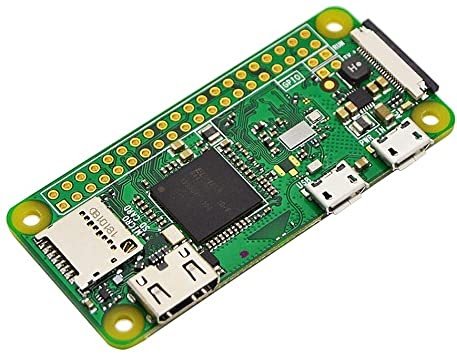
Raspberry Pi Zero
Using Raspberry microcomputers you can build real Linux machines to manage D-One software data. You can build micro backup servers to archive your data every day. Since these computers already include Wi-Fi and Bluetooth, they can be placed in practically any context. And with a full GPIO, the D-One system can be interfaced with electronic sensors to collect any kind of data and send it to the cloud. Given how cheap this hardware is, you don’t need to build hundreds of units to keep costs down: you can build and develop even a single unit.
Below you’ll find two examples that D-One has developed using this technology and the cloud system. What the two systems have in common is that they collect and store data even offline, and send it as soon as a connection is available.
WORK SITE ATTENDANCE TRACKING SYSTEM
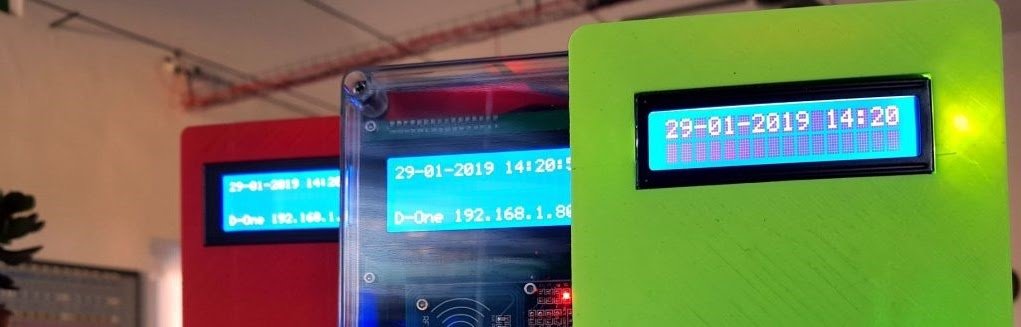
The project led to a tool for tracking, in the field, the presence of workers on construction sites and other non-fixed work areas. Using RFID badges, the tool records when workers enter and leave specific work areas and stores the information internally. Then, through a Wi-Fi connection or a smartphone, the stored data is sent to a central server to be processed and reviewed.
Looking at the competition, we found only one attendance tracker, with very high costs for both the hardware and the software and smartphone apps. Given our customers’ profile, we decided to build a low-cost tool with features that allow it to be used anywhere.
The goals were:
- Keep hardware costs low by using standard electronic components that are easy to find on the market, so that customers can even carry out maintenance themselves if needed.
- Be able to use the attendance tracker anywhere, even without any network connection and without a supervisor present. Since staff use RFID badges, it also works in extreme conditions, as no other phones are needed. The only phone used is the one that downloads the data to send it to the server, if needed.
- Have a built-in battery so it can be used anywhere, with the same power supply as smartphones, so that standard chargers and power banks can be used.
- Offer several configurations to better fit each customer’s needs. The configurations currently available cover the display size, whether it is waterproof, whether it has GPS positioning and whether it includes a GPRS module.
- Make it impossible to enter falsified data: smartphone apps that save the operator’s GPS position can easily be fooled by changing the coordinates with dedicated apps.
- Be able to receive and use the data both in the D-One management software and in other management systems, through targeted import and export features. This lets customers keep their current IT infrastructure without having to change it.
- Allow D-One to build targeted customizations that fully adapt how the tool works to the customer’s needs.
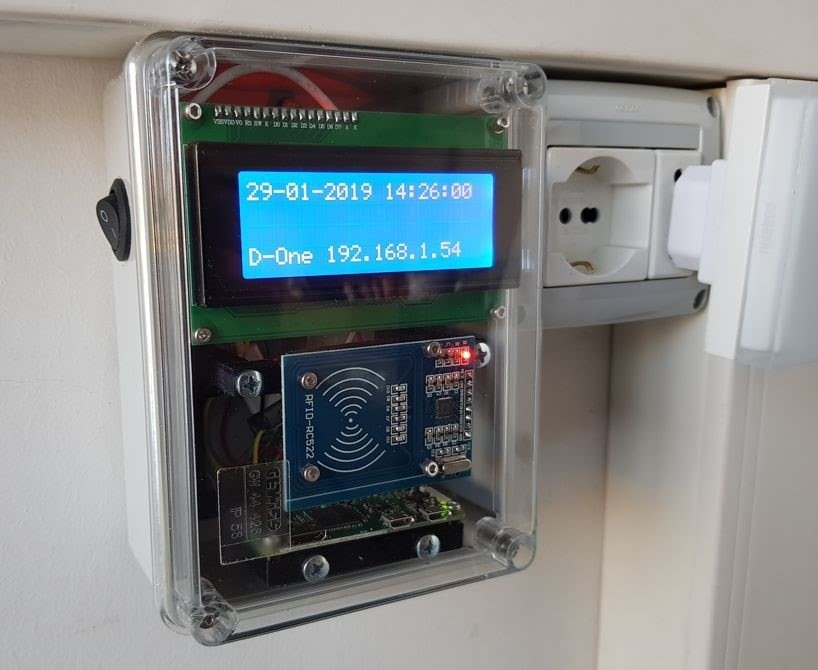
The Raspberry Pi Zero microcomputer was chosen as the base hardware. This system is well known as a base platform for IoT projects, thanks to its small size and very low cost. An LCD display, an RFID reader and a battery were connected to it. The more advanced versions also include a GPS module to save the position and a GPRS modem to send data directly in real time.
All the on-board software is written in Python, allowing complete customization. This is the first major difference from other attendance trackers, which by design are not computers and are therefore limited to the functions decided at the design stage. Our attendance tracker runs a real Linux computer, so it can be extended in any way, for any need.
Although it is possible with the GPRS transmission module, to reduce costs and above all to make the system completely self-sufficient, all data is stored inside the attendance tracker. So there are two specific ways to transfer the data:
- The first uses Wi-Fi. As soon as the attendance tracker detects network access, it sends the information to the server on its own and downloads any new data. This way the tracker can stay in the field all day and, at the end of the working day, be brought back to the office, where it synchronizes.
- The second uses a dedicated smartphone app that talks to the attendance tracker over Bluetooth. The app queries the tracker, receives the data and sends it on using the phone’s internet connection. Here too, if the smartphone has no coverage, it automatically sends the data retrieved from the tracker to the server as soon as an internet connection is available.
Both data transfer systems will be available on the attendance tracker, for the widest possible coverage.
The data will be stored on a cloud server, so it can be used both by the D-One management software and by dedicated applications that exchange this information with the company’s management system.
For those who don’t need management software, a web portal will also be available to manage operators and view access data, offering a complete stand-alone solution.
A client app for operators will also be developed, so they can view and check their entries into the various work areas.
Several prototypes have been built so far; they are used to test possible critical points and to show potential customers the system’s features and potential. Potential customers are responding positively to the attendance tracker, above all because it doesn’t need direct management and is completely self-sufficient in daily use. Their questions focus mainly on data management, which can’t yet be shown in detail because it is still being developed.
Development is now focusing on the system’s software and on the paperwork needed to obtain the trademarks and permits required to sell the device itself.